


The startup world moves fast. Ideas evolve quickly. Markets shift overnight in this constantly changing environment, speed and flexibility matter more than ever. That’s why many ventures rely on a Minimum Viable Product (MVP). It helps them launch fast, collect feedback from first-time users, and improve without wasting money.
Once an MVP hits the market, the cycle begins. Teams test. They redesign features. They make quick changes called iterations. Sometimes they make bigger changes called pivots. All of this helps validate the idea before investing in full development.
New ideas are rare today. Most product strategies come from small details—like a new feature or a fresh way to solve a problem. This is where the business model canvas MVP approach helps. Startups can evaluate and refine their offering by listening to early adopters. This constant learning makes them stand out in crowded markets.
Compared to complete product development, MVP development is faster, cheaper, and more focused. It limits unnecessary spending and keeps teams aligned. With MVP software development, businesses can scale on their own terms. They can build brighter instead of bigger.
What Is a Minimum Viable Product?

A Minimum Viable Product is a simple version of a product that includes only essential features. It helps entrepreneurs validate their idea and gather early feedback. The goal is not perfection. The goal is learning.
Eric Ries, author of The Lean Startup, defines it best:
A Minimum Viable Product is the version of a new product that allows a team to collect the maximum amount of validated learning with the least effort.
You launch small. You learn fast. You improve wisely.
Here are a few clear MVP examples:
- A basic food-ordering app that lets customers browse restaurants and place orders.
- A simple web browser that loads pages and has only three functions: back, forward, and a URL bar.
- A starter video game where users can shoot zombies, but features like a leaderboard come later.
These early versions are not polished. They exist to test market response. Even non-tech brands follow this model. A fast-food outlet launching a trial sandwich is a real-world MVP. They release it to a limited audience to check demand.
Why Build an MVP?
The benefits of MVP development are enormous. Startups can achieve faster market entry, helping them capture attention early. They also understand what users want before investing heavily.
Here’s what an MVP helps you achieve:
- Better market timing
- Initial demand insights
- Clear product idea validation
- More intelligent decision-making based on MVP user feedback
- Lower development cost
- Higher investor confidence
An MVP also supports agile development, enabling teams to improve features quickly. They learn what works. They refine what doesn’t. This creates strong long-term product success.
Great companies didn’t start as giants. They began small with a smart MVP product strategy, vigorous testing, and constant iteration. Whether it’s app development, ecommerce development, or a new tech idea, the MVP approach remains one of the most reliable paths to growth.
Different Types of MVPs You Can Build Today
When you create a Minimum Viable Product, you want something simple, straightforward, and fast to test. That’s why understanding the types of MVPs is so essential. Each type helps you validate a product idea differently. Some MVPs are quick to build. Others offer a more polished experience. Together, they form a strong MVP framework for startups that want to learn fast and improve even faster.
Broadly, MVP types fall into two groups: low-fidelity and high-fidelity. Both achieve the same goal, but they take different paths to get there.
Low-Fidelity MVPs
A low-fidelity MVP is simple. It doesn’t function like a real product. Instead, it explains the idea. It helps you gauge user interest before building anything. This approach is excellent for MVP concept testing, early feedback, and quick validation of product ideas.
Teams use basic tools to test demand. They often use websites, ads, or short videos. These tools help test price points, preferred features, and user reactions.
Popular Low-Fidelity MVP Models
- Landing Page MVP: This MVP uses a single landing page to explain the idea. Companies can collect emails and track clicks. It’s a strong way to validate interest early.
- Marketing Campaign MVP: This MVP relies on ads, newsletters, and social media posts. The goal is simple—build buzz and attract early adopters before development begins.
- Explainer Video MVP: This MVP breaks down a complex idea in a short, clear video. It helps people quickly understand the value. Dropbox famously used this exact model to validate demand.
High-Fidelity MVPs
A high-fidelity MVP is functional. It focuses on a core feature that solves a real problem. It may not be fully automated. Sometimes people handle tasks manually behind the scenes. But it still offers a usable product experience.
This approach is perfect for MVP testing, early-adopter testing, and gathering deep insights for future versions.
Popular High-Fidelity MVP Models
- Single Feature MVP: This model delivers one powerful feature. It gives users something tangible to try. The feedback helps teams plan future iterations.
- Wizard of Oz MVP: This MVP looks fully automated. But behind the scenes, humans do the work. Jeff Bezos used this trick in Amazon’s early days to test demand before building systems.
- Piecemeal MVP: This MVP uses existing tools and services to deliver the core product experience. Teams add custom features later if the idea proves successful.
Every big company starts small. Many iconic brands began with a simple test version of their product. These successful MVP examples prove that a bright start can lead to massive growth. When you study these Minimum Viable Product examples, you learn how small ideas turn into global businesses.
- Amazon – From a Simple Bookstore to a Global Empire
Amazon is one of the most iconic real-world MVP examples. But very few people know it started as a simple online bookstore in the early 1990s. The internet was new. People didn’t trust online purchasing. Building a site that sold everything felt impossible. But Jeff Bezos had a bold vision.
He came across a report predicting that web commerce would grow by 2,300% in the coming years. This pushed him to launch a Minimum Viable Product instead of a complete marketplace. He listed books online because they were easy to sell, had global demand, and came in thousands of titles. This became the foundation of the Amazon MVP story.
Instead of building a big store, Bezos kept things simple. He bought books from distributors and sold them on a basic website. No major design. No complex features. Just pure testing. Orders began to climb, proving his idea was valid.
This was one of the earliest MVP testing success stories. As book sales grew, Amazon added more categories, more features, and eventually warehouses. What started as a small MVP turned into the largest global retailer outside China. Today, Amazon is also a benchmark for MVP strategies and is studied by Shopify development companies for its e-commerce excellence.
Amazon’s journey highlights how MVP product validation stories can lead to massive business impact—even influencing modern ecommerce development approaches worldwide.
- Turo – A Car-Sharing MVP That Disrupted an Entire Industry
Turo is another powerful example of a successful MVP. Launched in 2009 by Shelby Clark, Tara Reeves, and Nabeel Al-Kady, the idea came to Clark during a harsh winter ride. He biked through icy roads to rent a car two miles away. Along the route, he noticed many parked vehicles. That sparked the idea: Why not let people rent out their unused cars?
This was the beginning of the Turo MVP example.
The biggest challenge was insurance. It took nearly 18 months to create a workable solution. When they finally launched under the name RelayRides, the MVP tested whether people would share personal cars with strangers.
Soon, competition arrived. Uber and Lyft were growing fast. But RelayRides kept improving. They expanded to San Francisco and saw demand rise. Later, the company rebranded as Turo in 2015.
Today, Turo has over 10 million users and more than 350,000 listed cars. Its annual revenue is close to $900 million. This is one of the strongest MVP innovation stories in the car-sharing space.
And here’s what makes Turo special: There is still no other massive P2P car rental competitor in the market. This leaves room to create similar platforms using smart MVP testing and MVP launch examples.
Turo’s growth is also referenced in MVP development inspiration guides and startup playbooks worldwide.
- Dropbox – A Simple Video MVP That Attracted 70,000+ Users
Dropbox is one of the most brilliant Minimum Viable Product examples ever created. Founded in 2007 by Drew Houston and Arash Ferdowsi, the idea was challenging. They wanted to build a cloud-based file syncing system. But building hardware and infrastructure would take time and money. So they created a different kind of MVP.
They made a simple video.
Yes, the Dropbox MVP video was their entire MVP. It showed how the product would work in the future. It wasn’t a real demo. But it clearly explained the value: all your files, from all your devices, in one place.
The response was explosive. More than 70,000 people signed up after watching the video.
This early feedback shaped the product. The team even reverse-engineered Apple’s Finder system to place their own icon in the top dock. Steve Jobs himself showed interest in acquiring the company.
Dropbox could have sold early. But they kept going. Today, the platform offers cloud storage, syncing, personal cloud features, and client apps. It now serves over 50 million users—three times as many as before. This remains one of the top MVP success stories and a masterclass in lean startup.
Dropbox also inspired countless founders to validate ideas without code, a trend now common in startup guides and in startup growth through MVP strategies.
- Foursquare – A Simple Check-In MVP That Turned Into a Global City Guide
Foursquare began in 2009 as a fundamental app. It was a Minimum Viable Product example that offered just one core feature—checking in at locations. Users could share their location, earn badges, and compete with friends. That’s it. No fancy interface. No complex tools. Just simple gamification.
This was one of the most fun real-world MVP examples. People loved earning badges. They loved the playful experience. And that excitement pushed the app into popularity fast.
As the user base grew, the team expanded the product. They added features that helped people discover restaurants, hotels, hangout spots, and entertainment venues. Slowly, Foursquare evolved into a global guide to city discovery.
This journey is a perfect example of validating the MVP concept. Start small. Test one feature. Watch what people love. Then expand with confidence.
Foursquare is now referenced in many top MVP case studies, especially for founders building location-based apps and social networks.
- AdWords Express – When a Manual MVP Led to Full Automation
AdWords Express MVP is an excellent reminder that an MVP doesn’t need to be high-tech. When Google launched this version of its ad product, it looked automated from the outside. Users typed their requirements. Within minutes, polished ad copies appeared.
But behind the scenes?
Students were manually writing the ads.
This clever trick helped Google determine whether people wanted quick, auto-generated ad text. And the results were precise—business owners loved the idea. Once the concept was validated, Google fully automated the system and expanded it.
This approach is often cited in MVP case studies as “The Wizard Behind the Curtain.” You make it look automated while humans deliver results. It’s an innovative MVP approach for startups that want to validate ideas quickly.
AdWords Express proves that MVP strategy examples don’t always require coding. Sometimes the best test is simple, fast, and human-powered.
- Groupon – A Piecemeal MVP That Grew Into a Global Deals Giant
Groupon started in 2008 as one of the most classic Groupon MVP model stories. Instead of building a big platform, the founders used a simple WordPress website. They promoted deals from local businesses. When people subscribed, the team emailed PDF coupons manually.
Yes—one coupon at a time.
This MVP collected valuable behavior data. The team learned what deals people liked, when they redeemed them, and which businesses saw the best results. They used this early data to build the powerful version of Groupon we know today.
This evolution is one of the strongest examples of an MVP business in digital marketplaces. It proves you can test demand using tools you already have. No custom development. No heavy investment. Just smart testing and clear market testing with MVP.
Today, Groupon operates globally with millions of users. It remains a go-to case study for founders creating marketplaces, especially in ecommerce development and discount-based platforms. Many Shopify development companies study Groupon’s MVP structure to guide clients.
- Instagram – A Simple Photo App That Became a Cultural Phenomenon
Instagram is one of the world’s most famous successful MVP examples. When it launched, it offered only two things: photo sharing and filters. That’s all. Kevin Systrom wanted to see if people enjoyed editing and posting images in a clean, simple app.
He was right.
Users loved the experience. The feedback was instant and positive. This early traction encouraged the team to scale fast. Over time, Instagram added messaging, stories, business profiles, live streaming, tagging, and hashtags. Each feature came from user demand and early testing.
Today, Instagram has more than 1.07 billion users worldwide. It’s impossible to imagine today’s social media ecosystem without it. This makes Instagram a prime example of startup growth through MVP and a key highlight in MVP success stories around the world.
Instagram also showcases how powerful early adopters’ case studies can be when building social apps.
- Facebook – A Simple Campus MVP That Became a Global Social Network
Facebook is one of the strongest Minimum Viable Product examples in tech history. In 2004, Mark Zuckerberg launched a simple platform for Harvard students. The idea was straightforward—let students connect, share updates, and post messages.
The MVP was extremely basic—no news feed. No pages. No groups. No marketplace.
But the concept clicked.
Students loved the experience, and word spread fast across other universities. This early traction gave Zuckerberg the confidence to grow the platform. Features were added slowly—profile photos, wall posts, notifications, and eventually global access.
What started as a student-only MVP soon became one of the most famous MVPs ever. Facebook now reaches billions of users and is featured in countless MVP startup journeys and lean startup MVP examples.
It also shaped how founders approach social media platforms, especially when validating new ideas through MVP testing success and early community building.
- Zappos – A Simple Shoe MVP That Changed Online Retail Forever
Zappos began in 1999 with a small and scrappy MVP. Nick Swinmurn, the founder, wanted to know if people would buy shoes online without trying them first. Instead of building a whole store, he used a straightforward approach.
He photographed shoes from local stores. Then he listed them on a basic website called Shoesite.com. When someone placed an order, he bought the shoes at full price and shipped them manually.
It was one of the earliest MVP case studies in online retail. The idea was straightforward—test demand before investing in inventory.
The results proved the concept. People were willing to buy shoes online. This helped Zappos refine pricing, logistics, and customer service. Amazon later acquired Zappos for $1.2 billion in 2009. Since then, Zappos has grown into a giant, generating more than $1 billion in annual sales.
This story is often cited as a key example in MVP business examples and MVP product validation stories, especially for founders in ecommerce development and marketplace platforms. Many Shopify development companies still reference Zappos while planning store validation strategies for clients.
- Airbnb – A Simple Room Rental MVP That Became a Hospitality Giant
Airbnb is one of the most inspiring successful MVP examples ever. In 2007, Brian Chesky and Joe Gebbia struggled to pay rent in San Francisco. They noticed that a large design conference had filled all nearby hotels. So they posted an ad online offering an “air bed” in their apartment.
They took a few photos. Uploaded them to a simple webpage. And waited.
Within days, they got three guests.
That single test validated the entire idea. People were willing to stay in someone else’s home if the price was right and the booking experience felt safe.
From that tiny MVP, Airbnb grew fast. They added better listings, location filters, reviews, host profiles, and secure payment systems. Today, the platform offers millions of stays, events, restaurants, and unique travel experiences. Airbnb now has over 4 million listings and is valued at more than $30 billion.
This is one of the strongest MVP innovation stories and a cornerstone of the evolution of the startup MVP. Airbnb’s journey shows how testing a simple assumption can spark global impact.
How to Build an MVP: 5 Simple MVP Process Steps
Building an MVP takes thoughtful planning, clear goals, and quick execution. These five steps show you exactly how to make an MVP without wasting time or money.
Step 1: Spot the Problem That Needs a Solution
Start by finding a real problem. Look for challenges that current solutions fail to fix. Your goal is to find something people care about and may even be willing to pay for.
This step lays the groundwork for all subsequent decisions. When you identify a problem MVP, you avoid building random features. Instead, you stay aligned with what users actually need.
Step 2: Prioritise Features and Define Your MVP Scope
Your MVP must be sharp and focused. List all possible features. Then cut out everything that is not essential. This prevents scope creep and keeps the build simple.
Your MVP scope should only include features that prove your idea. When you prioritise MVP features, you speed up your launch and reach real users faster.
Step 3: Choose Your Technologies
Your tech stack depends on the MVP types you choose.
For example:
- A single-feature MVP may require product design tools.
- An MVP landing page only needs a page builder and feedback tools.
- A Wizard of Oz MVP may require manual operations behind the scenes.
- A piecemeal MVP may use existing tools before building custom code.
Also, your budget and long-term goals shape the technologies you select. To keep the build simple, many startups begin with tools from Shopify development companies or other no-code options before investing in custom development.
Step 4: Launch Your MVP
A launch does not mean a big event. A soft launch works best for MVPs.
You can push your MVP with a few social posts, a small email campaign, or targeted ads. This is enough to get your first real users. The goal is simple—get feedback fast.
A quick MVP launch tells you if users understand your idea and whether they want to explore the product further.
Step 5: Evaluate Feedback and User Behavior
Your first users are your biggest asset. Watch how they interact with your product. Ask them what they enjoyed and what didn’t make sense. Use tools like Hotjar or CrazyEgg to collect MVP user feedback and track MVP user behavior.
Then iterate quickly. Remove features people don’t use. Improve the ones they love. This cycle of feedback, testing, and improvement builds a stronger product.
Benefits of Minimum Viable Products
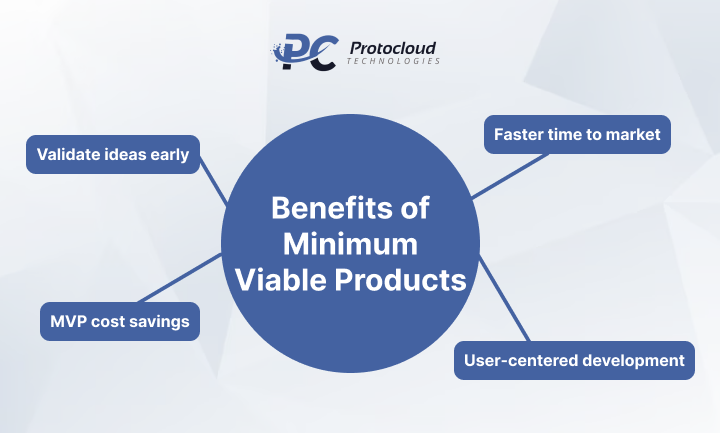
The benefits of MVP development are powerful. That’s why startups in software, health tech, and even ecommerce development use this model to reduce risk and speed up growth.
- Validate ideas early: You learn quickly if customers actually want what you’re building. This prevents months of wasted effort.
- MVP cost savings: You invest only in the essential parts of the product. No bloated features. No unnecessary delays.
- Faster time to market: You launch quickly, get reactions, and adjust. This speed gives small teams a competitive edge.
- User-centred development: Real users shape your roadmap. This improves UX, builds trust, and ensures the final product fits customer needs.
This approach encourages product validation, faster adaptation, and more intelligent decision-making. Many global brands started with small MVPs before building the whole product.
Conclusion
In today’s fast-moving market, building a perfect product from day one is no longer practical. The Minimum Viable Product approach reduces risk and helps teams move fast. It lets you test fundamental ideas with real people before investing heavily in development. Many successful software companies—and even major Shopify development companies—use MVPs to validate early concepts and build profitable digital products.
If you want trusted MVP software development services, consider FATbit Technologies as a strong partner
Why Consider Protocloud Technologies?
Protocloud Technologies has been developing MVPs since 2008. With 8+ years of industry experience, the company has guided startups, enterprises, and global brands across different industries. Their team includes MVP development experts who understand how to turn an idea into a market-ready test version.
They offer full support—from planning and design to launch and iteration. Protocloud also provides MVP technical support to ensure a smooth user experience.
Working with Protocloud means you partner with a seasoned MVP development company focused on tangible outcomes and sustainable product growth.
Frequently Asked Questions
- How much should an MVP cost?
The MVP cost depends on what you want to build. A small landing page MVP may cost almost nothing. An enterprise-level MVP can cross $100,000. For accuracy, it’s best to talk directly with experts.
- How to test an MVP?
You can test an MVP by gathering user feedback and tracking behavior.
- Low-fidelity MVPs use forms and emails.
- High-fidelity MVPs use tools like CrazyEgg or Hotjar.
- How does an MVP differ from a BPV?
A Billable Viable Product (BPV) works like an MVP but charges users. It provides stronger validation and helps shape pricing.
- How is a Minimum Viable Product (MVP) defined in SAFe?
In Scaled Agile MVP environments, the MVP tests the epic hypothesis. It helps teams decide whether to continue building a feature or pivot.





















Leave a Reply