


Security needs are growing fast. People and assets must always stay protected. For companies, assets are often worth millions. This necessitates 24/7 proactive surveillance.
AI surveillance offers the most reliable solution. Even homes now prefer AI-powered surveillance systems for safety.
Old CCTVs that need human monitoring are becoming outdated. Today, AI surveillance systems are in high demand for their advanced capabilities that enhance monitoring and security. These systems can be installed anywhere—schools, parking lots, industries, or movie theaters.
However, many organizations still feel confused about the cost, benefits, and setup process of AI-based CCTV systems.
What is AI in Surveillance Systems?
Traditional CCTVs record video and are monitored by humans. AI is changing how CCTV works. It reduces manual work and detects issues faster.
Simply put, AI in surveillance means adding artificial intelligence to CCTV cameras and video monitoring.
Modern AI surveillance systems can:
- Identify and track people or objects (AI object tracking)
- Provide automated monitoring
- Recognize faces, number plates, and patterns
- Detect unusual activity (AI anomaly detection)
- Send real-time alerts
- Identify and prevent threats (AI threat detection)
How AI Enhances Traditional Surveillance
Human monitoring has issues like tiredness, mistakes, and slow response.
AI surveillance solves these issues with smart, automated support.
Key improvements include:
- Automation – reduces manual work
- Accuracy – lowers the chances of errors
- Speed – gives instant alerts and faster responses
- Scalability – allows easy system upgrades anytime
With AI monitoring systems and AI surveillance, organizations can reduce risks, save money, and maintain complete control over safety.
Key Benefits of AI in Surveillance Systems

The demand for smarter security is growing fast. Today, organizations, public spaces, and even homes rely on AI in surveillance to protect people, assets, and property.
Traditional CCTV systems struggle with human error and slow response times. But AI surveillance systems change the game with automation, accuracy, and real-time insights.
Below is a complete breakdown of the top AI surveillance benefits, explained in a simple, conversational way.
- Enhanced Public Safety
AI-powered surveillance greatly improves safety in crowded and sensitive spaces. It uses AI behavior analysis to detect unusual patterns or suspicious activities within seconds.
These systems study movement, track objects, and spot anomalies in real time. As a result, authorities receive real-time AI-generated alerts, enabling faster action.
This proactive approach helps prevent threats, reduce crime, and build trust in public places such as malls, airports, and events. With AI public safety monitoring, nothing gets overlooked.
- Flexibility and Scalability
One significant advantage of AI in traditional surveillance is flexibility. Businesses can customize the system based on their specific needs.
As companies grow, their security needs evolve. AI systems can scale easily without major changes. You can add new features, integrate advanced sensors, or upgrade analytics with ease.
This adaptability makes AI surveillance technology a long-term investment for organizations of any size.
- Cost Savings
AI reduces costs by cutting the need for constant human monitoring. Since AI handles automated monitoring, businesses need fewer on-site security personnel.
It also cuts costs by reducing false alarms, improving accuracy, and streamlining workflows. These innovative features lead to significant AI cost savings in surveillance and enable teams to focus on strategic tasks rather than routine monitoring.
- Stronger Cybersecurity
Cyber threats are rising every day. Traditional systems fail to defend against complex intrusions. But AI cybersecurity systems offer advanced protection.
They use machine learning to study attack patterns, predict breaches, and strengthen defenses. With AI cyber threat detection, businesses get real-time warnings before damage occurs.
AI also supports intrusion prevention, helping organizations stay ahead of modern cyberattacks.
- Enhanced Security & Threat Detection
AI improves threat detection with smart video analysis. The system uses AI video analysis and AI threat detection systems to analyze movements, patterns, and behaviors.
Whether it’s unusual motion, restricted area entry, or suspicious behavior, the system issues alerts immediately. This enhances safety and significantly reduces the risk of security breaches in high-risk environments.
- Reduced Workload for Security Teams
AI handles repetitive tasks so staff work less. By filtering irrelevant footage, reducing false alerts, and highlighting real threats, AI lowers mental fatigue.
This helps security teams focus on decision-making rather than continuous monitoring. The result is higher efficiency, better resource use, and a more effective workforce supported by AI security staff support tools.
- Faster Response Times
Speed matters in security.AI processes large video footage instantly. They detect danger within seconds, enabling quick decision-making.
In critical settings such as hospitals, airports, or public events, faster responses can prevent disasters. This real-time capability is one of the most significant advantages of AI surveillance.
- Wide Applications Across Industries
The versatility of AI surveillance solutions makes them useful in many sectors.
Here are some common AI surveillance use cases:
- Retail: Prevent shoplifting, analyze customer flow, and secure entrances.
- Transportation: Monitor stations, track suspicious behavior, and manage crowds.
- Healthcare: Protect patients, monitor restricted zones, and ensure compliance.
- Public Safety: Detect crime, track vehicles, support law enforcement.
These applications demonstrate how AI surveillance improves security and efficiency across diverse environments.
Popular Use Cases of AI Surveillance Systems
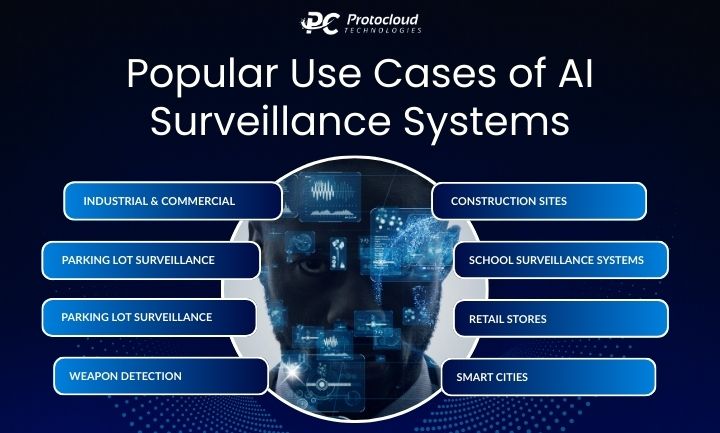
AI surveillance is becoming a must-have for every industry today. And the reason is simple. It works anywhere. Big spaces, small areas, busy environments, or restricted zones — AI surveillance systems make monitoring smarter, faster, and more reliable.
Even a small home or a startup unit can benefit from AI surveillance. It scales easily, adapts quickly, and improves safety instantly.
Below are the top AI surveillance use cases you can see across industries.
-
AI Surveillance for Construction Sites
Construction sites face daily hazards. Fire, unsafe heights, and machine mishandling can cause heavy losses within minutes. With AI surveillance and AI construction surveillance, companies can identify risks early.
The system tracks unsafe actions, detects hazards, and sends real-time alerts. These innovative features help prevent accidents and boost worker safety.
- AI-Enabled School Surveillance Systems
Parents want secure school environments. But manual monitoring isn’t enough for large campuses. AI surveillance solves this problem. Schools can use AI school surveillance to track students across entrances, corridors, and playgrounds.
With AI behavior analysis and AI real-time alerts, schools can prevent bullying, trespassing, and emergencies — all while keeping response time fast.
-
AI-Powered Parking Lot Surveillance
Parking areas face issues like theft, confusion, and mismanagement. AI surveillance helps here with AI parking lot surveillance, AI movement detection, and AI number plate recognition.
These tools detect suspicious actions, track stolen vehicles, and automate access control. Businesses also use AI parking management to optimize parking space and reduce traffic chaos.
-
AI Software for Weapon Detection in Public Spaces
Gun-related incidents in malls and theaters are increasing. AI surveillance makes these spaces safer. With AI gun-detection software and AI weapon-detection systems, authorities can detect weapons instantly.
It sends fast alerts to security teams, helping prevent tragedies before they occur. This makes AI surveillance critical for public safety.
-
Industrial & Commercial AI Surveillance
Factories and offices deal with workflow issues, fire risks, theft, and equipment failures. AI surveillance improves monitoring with AI industrial surveillance, AI workflow monitoring, and AI threat detection systems.
It tracks employee safety, asset movement, and operational activity 24/7. Businesses gain better productivity, fewer losses, and stronger security.
-
AI-Powered Traffic Surveillance
Traffic management is one of the biggest challenges modern cities face today. AI surveillance helps detect accidents, track violations, and analyze road conditions.
With AI transportation surveillance, authorities can maintain smoother traffic flow and enhance public safety. Many nations now rely on AI traffic surveillance to manage busy intersections and reduce congestion.
-
AI Surveillance in Retail Stores
Retail stores must watch visitors and employees to avoid losses. AI surveillance provides AI retail surveillance, AI unusual activity detection, and AI object tracking to reduce shoplifting and improve customer flow.
It also studies footfall patterns and helps stores optimize layouts. AI surveillance improves both security and customer experience.
-
AI Surveillance for Smart Cities
Cities are rapidly adopting AI surveillance to improve safety and efficiency. With AI-powered intelligent city surveillance, authorities can manage crowds, monitor pollution, detect crime, and control traffic with ease.
These systems connect with IoT devices and analytics tools to enhance response times and resource management.
Challenges in Implementing AI in Surveillance Systems
Implementing AI surveillance sounds simple. But once you dive in, you discover real challenges. Organizations often struggle with privacy, ethics, data protection, and tech roadblocks. Let’s break down these hurdles and explore practical solutions.
-
Privacy Concerns
AI in surveillance collects and analyzes massive amounts of data. That creates serious AI privacy concerns, especially in public spaces. People worry about over-monitoring and losing control over their personal information.
Solution:
Organizations need strong AI security systems, clear policies, and transparent practices. When users understand how AI monitoring works, they feel safer. Encryption, consent workflows, and transparency around AI surveillance help protect privacy in traditional AI surveillance setups.
-
Ethical Dilemmas
AI behavior analysis, facial recognition, and pattern tracking often raise concerns about the ethics of AI surveillance. Bias, unfair decisions, and unintended results can damage public trust. AI algorithm bias remains a critical issue in AI-powered surveillance.
Solution:
Use responsible frameworks—test models for fairness. Be open about how AI threat detection and AI anomaly detection work. Clear guardrails improve public confidence in ethical AI surveillance.
-
Data Security and Integrity
AI surveillance systems generate vast volumes of sensitive data. Securing this data is tough. Breaches, manipulation, and cyberattacks can harm accuracy and reliability. AI data integrity, AI data security, and AI cyber threat detection become non-negotiable.
Solution:
Adopt strong AI cybersecurity systems, encryption layers, and intrusion controls. Follow AI GDPR compliance and global privacy standards. This ensures safe and AI-secure surveillance operations.
-
Technical Challenges
Integrating AI video surveillance with old hardware is rarely smooth. Algorithms need fine-tuning. Cameras face poor lighting, weather, or crowded environments. These hurdles affect the accuracy and performance of AI surveillance in real-time scenarios.
Solution:
Work with experts who understand AI surveillance integration and AI surveillance infrastructure. They help optimize models, boost AI video analysis, and ensure reliable real-time AI alerts with robust AI security automation.
Real-World Examples of Companies Using AI Video Surveillance
AI surveillance is transforming how companies protect assets, people, and daily operations. Many global brands already use AI in surveillance to boost security, improve efficiency, and gain real-time visibility. These examples show how modern AI surveillance systems deliver measurable impact across industries.
Vodafone
Vodafone uses AI-driven surveillance, combined with IoT devices, to monitor critical infrastructure. This setup ensures comprehensive asset monitoring, reduces security risks, and strengthens overall protection.
Their approach highlights the value of AI-powered surveillance and AI monitoring at scale.
Amazon Go
Amazon Go relies on advanced AI video surveillance and smart sensors inside its 1,800-square-foot automated store. It’s “Just Walk Out Technology” tracks products, detects movements, and bills customers instantly.
This model shows how AI surveillance improves the customer experience through AI anomaly detection and real-time alerts.
Tesla
Tesla vehicles use AI surveillance technology to improve car security. Cameras detect suspicious movements, trigger alarms, and notify the owner.
This showcases AI automated monitoring, strong AI cyber threat detection, and AI intrusion prevention in smart vehicles.
Google Nest
Google Nest applies AI surveillance in smart home security systems. Its cameras detect unusual behavior and distinguish routine activity from real threats.
This blend of AI behavior analysis and AI-enhanced security gives homeowners peace of mind.
Changi Airport
Changi Airport in Singapore uses AI-powered surveillance to improve traveler safety. The system detects unauthorized access, unusual behavior, and crowd-flow issues.
This demonstrates reliable AI threat detection, AI surveillance transparency, and AI surveillance accuracy at scale.
Future of AI in Surveillance Systems
The future of AI surveillance is expanding fast. Edge AI, IoT integration, advanced analytics, and improved facial recognition update security every day.
We will soon see AI surveillance systems integrated with drones, predictive crime mapping, and more intelligent sensors.
Scalability is another significant advantage of AI surveillance solutions.Businesses can upgrade, modify, or add features at any time without replacing the system.
With strong AI surveillance infrastructure, organizations enhance AI data security, AI surveillance compliance, and long-term reliability. AI partners like Fulminous Software offer customizable, upgradable AI surveillance solutions tailored to your needs.
They help companies overcome AI implementation challenges, strengthen AI surveillance data protection, and adopt AI surveillance best practices.









































































Leave a Reply