


The Stage Gate Process has a long history. It started in industries where risk management and compliance shaped every move. Even today, this structured approach supports companies that rely on strict controls and predictable decisions. But the method can feel rigid in fast-moving IT environments. That’s why many teams adapt the stage gate process or blend it with agile practices to stay flexible.
Modern IT teams want balance. Some like the firm structure of classical models, while others prefer the speed of Agile. But in real projects, both extremes can fail. Agile teams can slip into scope creep because they lack direction. Traditional models can become slow, bureaucratic, and overly document-intensive. So teams now search for a middle ground.
In this article, we explore how the stage gate process in SDLC works and why it still benefits IT teams. It began as a risk-reduction tactic in industries such as aerospace and pharma. Today, the stage gate methodology is gaining traction in the digital world because it brings clarity and control to complex work.
What Is the Stage Gate Process?
The stage-gate process divides a project into distinct phases. Each phase ends with a decision point called a “gate.” These stage gate phases help teams decide whether to continue, adjust, or stop. The method is not the most common approach in software development, but it works well in some instances.
The model came from New Product Development (NPD) in the 1960s. Companies at the time needed a structured way to manage large, complex, and high-risk projects. Strict regulations made mistakes expensive. The new product development stage-gate template provided them with a step-by-step system and clear go/no-go decisions to stay on track.
How Stage Gate Works in Software Development
In software, the stage-gate process is a hybrid. It sits between Waterfall and Agile. Some compare it with the Spiral Model and the Rational Unified Process (RUP) because these models also combine structure with flexibility.
The stage-gate model used in the IT industry adds something many SDLC models skip: ideation and business case creation. These steps help teams build products that match real business needs. This makes the project more holistic. Production becomes a logical result of strategy, not just a technical step. This alone highlights several benefits of the stage-gate process.
Even though most SDLC models include milestones, the stage-gate methodology gives them a more profound meaning. It encourages smarter decisions through clear checkpoints. With the stage gate explained, teams get better visibility and more confidence before moving forward.
Where the Stage Gate Process Works Best
The stage-gate process for IT teams is suited to specific types of projects. It works well in environments where control and documentation matter most.
It is ideal for:
- Large complex software projects need a strong structure.
- Compliance-driven software development in regulated industries.
- Risk-averse companies’ software development relies on safer decision points.
Alternatives to the Stage Gate Methodology
Not every project needs a structured model. Many teams want speed and flexibility. Several alternatives can work better depending on the situation:
- Agile methodologies support rapid change and evolving requirements.
- Lean development alternatives, which focus on cutting waste and delivering value fast.
- Hybrid software development methodologies, which combine the best parts of multiple models.
These options are ideal when teams want adaptability over strict steps.
There is no universal best method. Your ideal approach depends on your project and your company’s needs. You don’t need to pick a side in the stage-gate vs. agile or stage-gate vs. waterfall debate. You can blend ideas and build a hybrid SDLC model that supports your workflow.
Use the parts of the stage gate process that help you stay organised. Skip the parts that slow you down. The goal is to create a custom software development methodology that fits your team. When you do that, you avoid robotic stand-ups, heavy paperwork, and slow progress. You support your team with real software development workflow optimisation that gets results.
The 5 Phases of Stage Gate Process
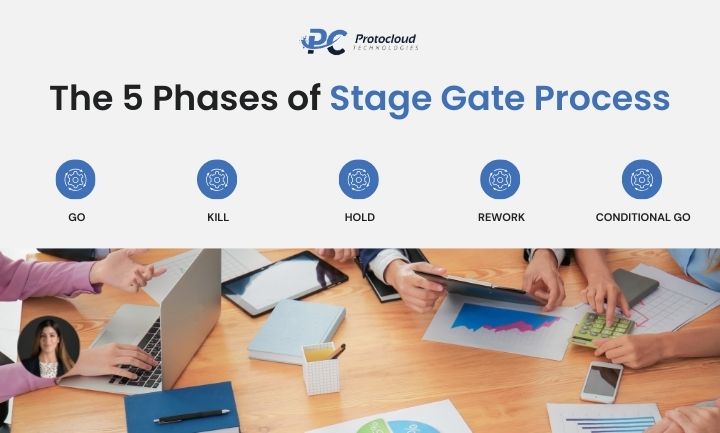
The stage-gate process helps you decide whether a project should move forward, pause, or stop. Each stage gives you data. Each gate demands a decision. This structure keeps teams focused, reduces risks, and ensures you build what the market truly wants.
Let’s break down the 5 phases of the stage gate process and what each outcome means.
The stage-gate methodology gives you five clear choices at each gate. These stage gate decisions keep your project aligned with real-world needs.
1. Go
You’re ready to move.
The tech works.
The market wants it.
Costs make sense.
This decision means the team can execute the plan with confidence.
2. Kill
Not every idea wins.
Maybe the market shifted.
Maybe costs outweigh value.
Ending the project frees resources for stronger opportunities. This is a core part of the kill hold rework conditional go meaning.
3. Hold
You stop temporarily.
You may wait for partners, approvals, or internal bandwidth.
Define clear stage gate criteria for when you will restart. This keeps decisions objective.
4. Rework
You need changes before moving forward.
Maybe users want new features.
Maybe the design or finances need adjustments.
Re-enter the race with a stronger, more refined plan.
5. Conditional Go
You can proceed, but only with conditions.
Hit specific milestones.
Remove uncertainties.
Secure approvals.
You prove your project is on track before going full speed. These choices form the backbone of stage gate decision outcomes.
The 6 Gates of the Stage Gate Process
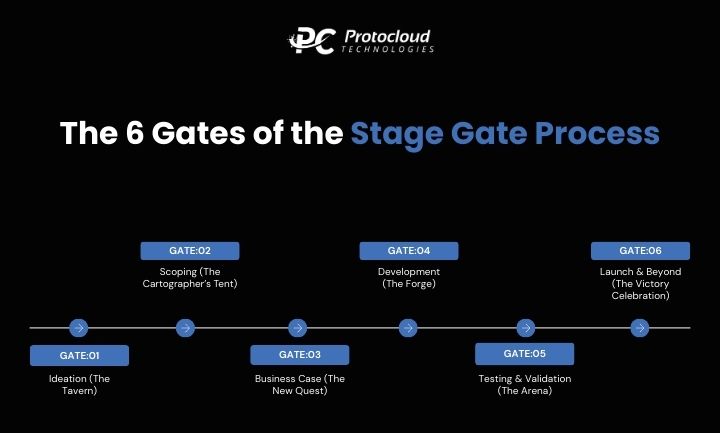
The stage gate model has six main checkpoints. Think of them as milestones in a role-playing game. Each gate is a quest marker. You must show progress before advancing.
This makes the stage gate workflow easier to understand, especially in software project stage gates.
Gate 1: Ideation (The Tavern)
This is where the spark begins.
You brainstorm ideas, identify the problem, and define the value.
This early step shapes your quest. It is the starting point of the ideation stage gate.
Gate 2: Scoping (The Cartographer’s Tent)
You map the journey.
You list essential, optional, and future features.
You define the tech stack, tools, and resources.
This becomes your scoping-stage-gate blueprint.
Gate 3: Business Case (The New Quest)
You pitch your plan to stakeholders.
You validate the market.
You identify the target audience.
You estimate revenue and risks.
This is where you justify the quest and secure approval through the stage-gate process.
Gate 4: Development (The Forge)
You start building.
You use your chosen stack to create features.
Your team works in sprints, improving the product incrementally.
This is the heart of the development stage gate.
Gate 5: Testing & Validation (The Arena)
You test your product in real conditions.
Users give feedback.
You fix issues, refine the design, and improve performance.
This is the core of both the testing and validation stage gates.
Gate 6: Launch & Beyond (The Victory Celebration)
You release your product.
You support users, track performance, and solve issues fast.
The quest never truly ends because markets evolve.
This makes the launch stage gate more of a beginning than an end.
When to Implement the Stage-Gate Model
The stage-gate process works best when managing large projects with many moving parts. It helps teams stay aligned, reduce risk, and move fast with confidence. You’ll commonly see the stage gate process used in new product development, software or website launches, and even business-wide transformation projects.
This structured stage-gate workflow provides teams with clarity at every step. Each phase has clear goals, and each gate requires solid data to move forward. This prevents guesswork and keeps the project on a predictable path.
New Product Development Projects
For product teams, the stage gate process provides a proven path from idea to launch.
Each stage focuses on a core task, such as ideation, market research, prototyping, testing, or commercialisation.
The gates serve as checkpoints. They check customer alignment, technical feasibility, and financial strength.
If the idea meets the stage-gate criteria, it moves smoothly to the next stage.
These checkpoints follow the familiar go-kill hold, rework conditional go decisions.
This ensures every idea is evaluated with clarity and discipline.
Research and Development (R&D) Projects
R&D work comes with uncertainty. Here, the stage-gate process helps break down complexity into small, manageable steps.
Teams move through ideation, proof of concept, prototyping, validation, and scaling.
Stakeholders evaluate technical feasibility and alignment with company goals at each gate.
This structured approach lowers risk and keeps innovation moving.
Capital-Intensive Projects
Capital-intensive projects—such as infrastructure or industrial plants—need careful control.
The stage-gate process supports high-investment projects with detailed planning and rigorous risk checks.
Common stages include feasibility studies, procurement, construction, and operational readiness.
Gates ensure compliance, cost validation, and resource availability.
This structured approach keeps stakeholders informed at every step.
Stage-Gate Process Example: Launching a Website
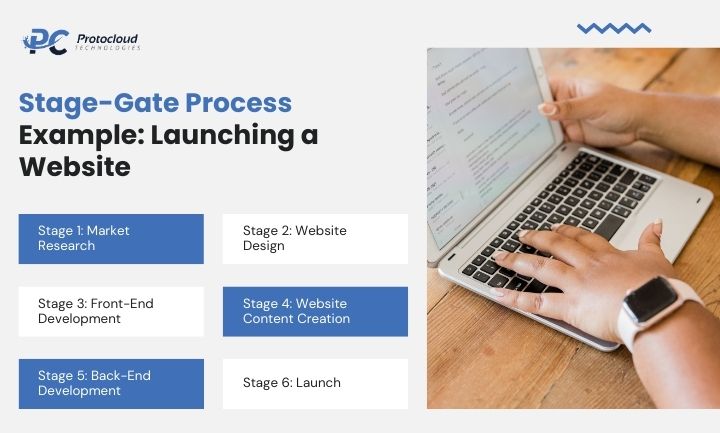
Here’s a simple stage gate process example for launching a website.
Each phase ends with a gate. The gate decides whether the project should move forward.
Stage 1: Market Research
Start with detailed research. Define your website goals, target audience, and competitors.
Deliverables include personas, objectives, and market insights.
Gate criteria include:
- Website purpose
- Audience clarity
- Feasibility
This mirrors the ideation stage gate.
Stage 2: Website Design
Build visual mockups with typography, layouts, and colours.
Your goal is a design that feels modern and aligned with your brand.
Gate checks:
- Design approval
- Brand alignment
Stage 3: Front-End Development
Turn the design into a working interface.
Use HTML, CSS, or JavaScript to build responsive, interactive pages.
Gate criteria:
- Functionality
- Responsiveness
- Cross-browser support
This aligns with the development stage gate.
Stage 4: Website Content Creation
Create and integrate all content—copy, images, and videos.
Optimise everything for SEO.
Gate checks:
- Accuracy
- Tone
- SEO compliance
Stage 5: Back-End Development
Build the server-side logic and database systems.
Ensure all integrations work smoothly.
Gate criteria:
- Performance
- Security
- Integration quality
Stage 6: Launch
Deploy the website to the live server.
Run final readiness checks.
Gate checks:
- Deployment checklist
- Live environment compatibility
Benefits of the Stage Gate Process
The stage-gate process provides teams with a clear path from idea to launch. It breaks work into steps and adds checkpoints that keep everyone aligned. This structure helps companies move fast, reduce risk, and make smarter decisions at every stage.
Transparency
- Clear stage gate phases and reviews improve communication.
- Teams stay aligned with goals and stage gate decisions.
- Better visibility improves stage-gate transparency for all stakeholders.
Flexibility
- The go-kill hold-rework conditional go choices help teams adapt quickly.
- If conditions change, projects can pause or rework without wasting resources.
- Helps maintain relevance in shifting markets.
Better Outcomes
- Early filtering improves the outcomes of the stage gate.
- Weak ideas get removed early, reducing financial losses.
- Strong ideas move faster through the stage gate workflow.
Advantages of the Stage Gate Model
- Works well in a stage gate for large companies with many stakeholders.
- Reduces random changes and supports the structured creativity stage gate.
- Improves speed by keeping teams focused on the right tasks.
- Provides strong alignment through the key gates of the stage gate process.
- Helps reduce risk through early evaluation and the rapid elimination of bad ideas.
- Supports smooth stage gate project management with clear milestones.
- Enhances planning by improving stage-gate resource allocation.
- Improves success rates by identifying issues early across the 5 phases of the stage-gate process.
Disadvantages of the Stage Gate Model
- Too many stakeholders can slow decision-making and introduce noise.
- Conflicting opinions can limit the stage gate creative process.
- May feel rigid and limit flexibility if not handled well.
- It can create bottlenecks when leadership alignment is weak.
- Heavy review cycles may slow down smaller teams.
- Some teams see it as too structured compared to agile methods, such as stage-gate vs. waterfall comparisons.
Wrapping Up
Overall, the stage gate process explanation comes down to three things: clarity, speed, and better decision-making. It reduces risk, improves teamwork, and boosts long-term outcomes.
Many global companies use it because it works. With stronger control, better planning, and fewer surprises, teams build products that succeed in the real world.









Leave a Reply