


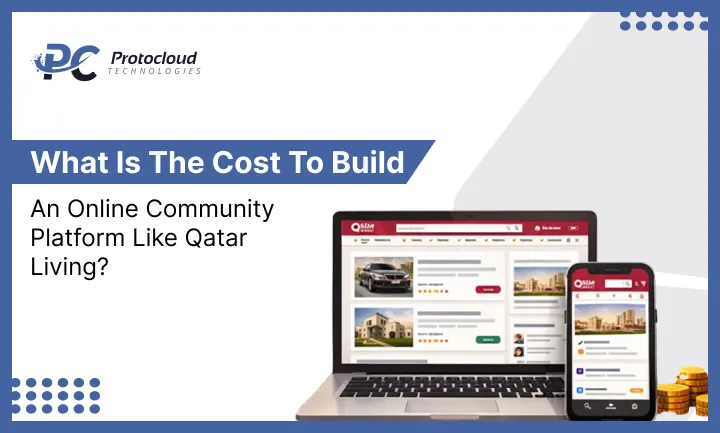
Building a community platform sounds exciting until the budget conversation starts. The truth is, there’s no single number. The cost to build an app like Qatar Living depends on what you’re actually building — and how seriously you’re thinking about scale, users, and long-term growth.
This guide breaks it all down, honestly and clearly.
What Does Online Community Platform Development Actually Cost?
The online community platform development cost lives on a spectrum. It depends on complexity, features, and the amount of traffic you expect to handle from day one.
Here’s how the community platform development cost breakdown looks across three tiers:
- MVP: QAR 109,200 – QAR 254,800 ($30,000 – $70,000) — core features, fast launch, early user testing
- Mid-Complexity: Up to QAR 1,092,000 (up to $300,000) — payments, messaging, user accounts, monetization
- Enterprise: QAR 2,184,000+ ($600,000+) — AI engines, microservices, millions of simultaneous users
Most businesses start by underestimating where they actually fall. A platform that looks like an MVP on paper often has mid-complexity requirements hiding underneath.
The Real Factors Driving Your Community Platform Development Cost
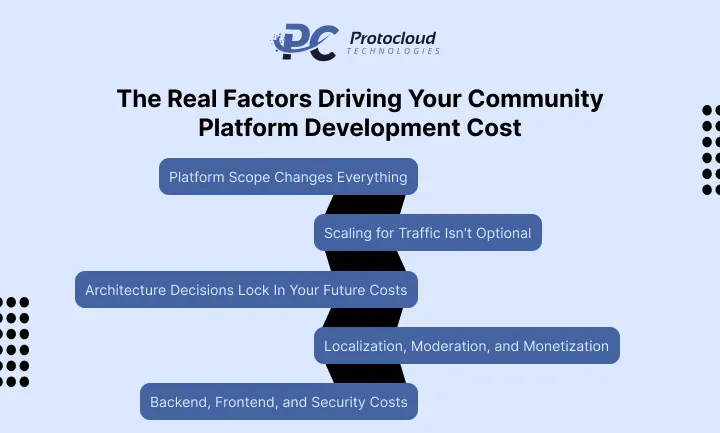
1.Platform Scope Changes Everything
A simple listings page and a full community marketplace platform are not the same product. The moment you add advanced search, user dashboards, admin controls, job boards, rental listings, and service categories, engineering complexity multiplies. Community platform features cost rises with every layer of depth you add. Depth creates user stickiness, but it never comes free.
2. Scaling for Traffic Isn’t Optional
Building for 5,000 users is genuinely different from building for 500,000. A scalable community platform needs caching layers, optimized databases, and backend infrastructure that handles spikes without slowing down. This is one of the biggest cost factors for community platform development that teams consistently underestimate. Treating infrastructure as an afterthought always costs more to fix later than building it right the first time.
3. Architecture Decisions Lock In Your Future Costs
Microservices vs monolithic cost community app decisions made in week one affect your budget for years. A monolithic build launches faster and costs less upfront. But as your platform grows, maintaining and extending it becomes expensive. The community platform architecture for a microservices approach is initially more expensive, but it supports long-term scaling without disruptive rebuilds. Leaders who plan for growth early almost always save more over a three-year window.
4. Localization, Moderation, and Monetization
Arabic community platform development cost is a real line item that many teams outside the region miss. Building for Qatar means Arabic language support, right-to-left design, and culturally aligned UX. RTL design cost community app work adds QA time, UI adjustments, and content restructuring. Global templates rarely work in regional markets, and the localization costs of community platform investment are what separate platforms that get adopted from those that get ignored.
The cost of the community platform’s moderation system is another area where cutting corners later hurts. Open communities attract spam, abuse, and bad actors. Reporting tools, content filters, and escalation workflows need to be designed, not bolted on. AI moderation costs community app features add build time, but protect your reputation at scale. Trust is a platform feature — and it has a real price tag.
On the revenue side, community platform monetization costs are higher than most founders expect. Ad engines, subscription model community app tiers, featured listings, and analytics dashboards each add complexity to your backend and UI. Platforms that plan monetization from day one build sustainability in. Platforms that add it later pay twice.
5. Backend, Frontend, and Security Costs
Backend development cost for the community platform covers your database architecture, API design, user role management, and server logic. User role management costs increase as community platforms grow and governance becomes more structured — admins, moderators, advertisers, and regular users all need different permission levels. Admin panel development costs for a community app are often underestimated, but they are essential for any platform operating at a meaningful scale.
Frontend development costs for the community app, and UI/UX costs for the community platform, depend on how polished and responsive you want the experience to be. A clean, fast interface on mobile and desktop requires real design investment.
The security cost community platform and the compliance cost community app are non-negotiable. Hosting user data creates legal exposure. GDPR data protection community platform cost planning protects the business from regulatory risk down the line. Skipping this phase reduces your upfront costs but significantly increases your long-term risk.
The Hidden Costs That Quietly Drain Your Budget
Community platform maintenance cost is the first surprise most businesses face post-launch. Security patches, bug fixes, framework updates, and performance improvements are not one-time tasks. They are ongoing responsibilities. Skipping them doesn’t save money — it accumulates technical debt that costs significantly more to fix later.
Content moderation costs for community app operations are another line item that catches teams off guard. An active community generates user-posted content constantly. That content needs reviewing, flagging, and managing. Social community app moderation cost grows directly with your user base. What feels manageable at 1,000 users becomes a real operational cost at 50,000.
Performance optimization cost community app work kicks in when real users start behaving in ways your test environment never predicted. Database queries slow down. Search responses lag. Pages load inconsistently under heavy traffic. Database optimization costs, community platform work, and speed-optimization community website costs are not optional — they’re what keep users from quietly leaving and never coming back.
Marketing Infrastructure Is Part of Your Tech Cost
This one surprises almost everyone. Marketing system cost community app isn’t just ad spend — it’s the actual technology underneath your growth engine. Push notification system, email marketing integration, community app, CRM integration, and analytics tools are all real development and licensing expenses. These systems need to be built or integrated properly. Without them, you’re promoting a platform you can’t actually measure or nurture.
Scope Creep and Feature Expansion Are Budget Killers
The feature expansion costs of community platforms are where many projects quietly go over budget. Users start making requests. The product team sees opportunities. Competitors launch something new. Before long, you’re adding features mid-development or right after launch — both of which are significantly more expensive than planning them upfront.
Adding new features to the community app costs after the core architecture is built often means reworking existing systems, not just adding on top. Scope creep community platform cost is real, and it’s almost always avoidable with better upfront planning. Decide what’s in scope before development starts — and protect that decision.
The complexity and cost of the community app’s admin panel are also underestimated. As the platform grows, user roles management costs and governance requirements expand. Multiple admin levels, permission structures, content approval workflows, and reporting views all add backend complexity to a community platform that wasn’t in the original estimate.
Infrastructure Scaling Isn’t a Future Problem — It’s a Now Decision
Scalable infrastructure costs community app decisions made early determine what you pay later. Cloud hosting costs, community platform costs, caching system costs, and server scaling costs. Community app configurations need to be thought through before traffic arrives — not during a crisis when the platform is already slow.
Platform upgrade cost, community app upgrade cost, and architecture upgrade cost. Community platform expenses take the biggest hit when teams try to bolt on scalability to a system that wasn’t designed for it. Early investment in proper architecture almost always costs less than emergency reconstruction under pressure.
Smart Ways to Optimize Your Community Platform Budget
Cost-optimization community platform development doesn’t mean building less—it means building smarter. Here are the strategies that actually work:
- Start with an MVP. An MVP community platform strategy reduces your initial investment by 60–70% while giving you real user data to guide what gets built next.
- Use the MoSCoW method. A feature prioritization community platform using Must/Should/Could/Won’t categories keeps development focused on what actually matters at launch.
- Choose cross-platform frameworks. The cost of React Native community app development and the cost of the Flutter community platform are both significantly lower than building separate native apps for iOS and Android. Cross-platform development cuts mobile costs by 30–40%.
The Features That Make Every Investment Worth It
Essential features for community platform products are not complicated; they must be done well. Cut corners here and users notice immediately, even if they can’t explain exactly why they stopped coming back.
- User Profiles: User profiles feature a community platform design that gives people a reason to build identity and reputation inside your community. Anonymous experiences feel disposable. Profiles create ownership, encourage return visits, and make users feel recognized and invested.
- Search and Filters: Fast, accurate search and filtering features, community-app functionality keep content discoverable at every stage of growth. Communities fail quietly when content is hard to find. Users don’t file complaints — they just leave without saying anything.
- Listings and Posting System: A clean listings system, community platform, and reliable posting system make contributing effortless. If posting feels slow or confusing, users stop posting. Fewer posts mean fewer reasons for others to visit.
- Moderation and Reporting Tools: Moderation tools, a community platform, and a solid reporting system help create an environment that makes your community worth joining. Open platforms without safety infrastructure attract bad actors quickly — and cleaning up is far more expensive than preventing them.
- Mobile-First Experience: A mobile-first community platform experience is non-negotiable in 2026. Most users discover and return through their phones. Slow load times and awkward mobile layouts stop growth cold — no marketing budget fixes a broken mobile experience.
- Notifications and Alerts: The community platform’s notifications feature keeps your community active between sessions. A smart, well-timed alerts system and community app reminders bring users back without feeling intrusive. This is a retention tool, not just a messaging feature.
- Admin Dashboard: A well-built admin dashboard community platform with usage tracking, content approval workflows, and performance visibility keeps operations clean. As governance grows, a powerful analytics dashboard community app layer turns guesswork into confident, data-driven decisions.
How to Develop a Platform like Qatar Living: The Process
Building a large community platform is not a development project. It is a business transformation exercise. The most common reason platforms fail is not technology. It is poor execution discipline. The online community platform development process works when it integrates strategy, engineering, design, and operations into a single, controlled delivery flow. Companies that treat it like an app build lose control of scope, budget, and performance within months.
Step 1: Strategic Market Positioning and Business Alignment
This phase answers one question: why should users choose your platform over anything else already available? This includes market gap analysis, validation workshops, and competitive teardown studies. Leadership decides whether the platform is horizontal, like Qatar Living, or purpose-built for one domain. Revenue logic is also defined here to avoid building features that cannot be monetized later.
Step 2: User Research and Behavioral Intelligence
Here, teams move beyond demographics and study intent, friction, and usage frequency. Research includes interviews, surveys, and analysis of activity patterns (how users search, scroll, save, and return). Real behavior maps define what screens matter and which features can be skipped. This avoids creating features nobody uses.
Step 3: Platform Planning and Feature Architecture
Once the user’s reality is understood, the feature system is designed as an ecosystem rather than as a set of standalone screens. Business decides what goes into Phase 1 versus what goes into later upgrades. This keeps delivery practical without sacrificing long-term ambition. The product roadmap is frozen here to protect scope control.
Step 4: System Architecture and Engineering Blueprint
This is the stage where you either control your costs—or let them slip away. Database design, cloud infrastructure, traffic handling, and system separation models are locked. Platform planning for growth is moving toward modular engineering rather than tightly coupled systems. This enables upgrades without platform shutdowns later.
Step 5: Experience Design and Usability Engineering
Design teams plan not only the layout but also the behavior. User stress analysis is performed to understand confusion points. Button placement, form logic, filter priorities, and display layouts are structured around speed and clarity. Consistency beats creativity here. The goal is a platform people trust without thinking.
Step 6: Product Development and Integration
This is execution. Development proceeds in layers: core logic, user flows, database connections, external APIs, payment hooks, and analytics feeds. Teams enforce testing alongside development to prevent defects from piling up. Integration testing ensures the platform behaves as a single system rather than fragmented modules. It is one of the crucial phases that affects the overall cost of building an online community platform like Qatar Living.
Step 7: Security Framework and Compliance Controls
Authentication systems, encryption policy, back-office access rules, and session control models are enforced. Abuse-prevention, system logging, and user-protection mechanisms are stress-tested. This phase protects both users and business credibility.
Step 8: Performance Testing and Load Engineering
Traffic simulation is not optional. Database stress tests and failure scenarios reveal weaknesses before public usage. Engineering teams tune response times and memory usage under pressure. Platforms that skip this quietly collapse later.
Step 9: Launch Planning and Real-World Rollout
This phase does not start with press releases. Pilot users are invited. Feedback is logged. Fix cycles run in real time. Risk is minimized before exposure. Businesses that rush this phase often face early reputation damage.
Step 10: Growth Infrastructure and Operational Scaling
Moderation processes, ticket handling, customer support systems, and performance monitoring dashboards go live. Teams establish governance models. This ensures platform behavior remains healthy as user numbers grow.
Step 11: Maintenance, Stability, and Continuous Improvement
This is not a phase. This is a permanent operation. Systems require patching, performance tuning, and security reinforcement. Bugs are corrected. Hosting load is adjusted. Feature improvements are based on user behavior data, not guesswork. Sustainable platforms work because their owners never stop fixing small things before they become big failures.
Why Choose Protocloud for Developing a Community Platform in Qatar
Building a platform like Qatar Living is not just about development — it’s about building a system that works in real life.
Protocloud Technologies focuses on creating platforms that are stable, fast, and easy to use. We first understand how your users behave — what they search, how they interact, and what keeps them coming back.
Our approach is simple:
Build strong → Make it fast → Add smart features
We also understand the Qatar market, including language, culture, and user expectations, so your platform feels natural and user-friendly.
And we don’t stop after launch. As your platform grows, Protocloud supports you with updates, improvements, and scaling.
Goal: Build a platform that works today and grows with your business


